
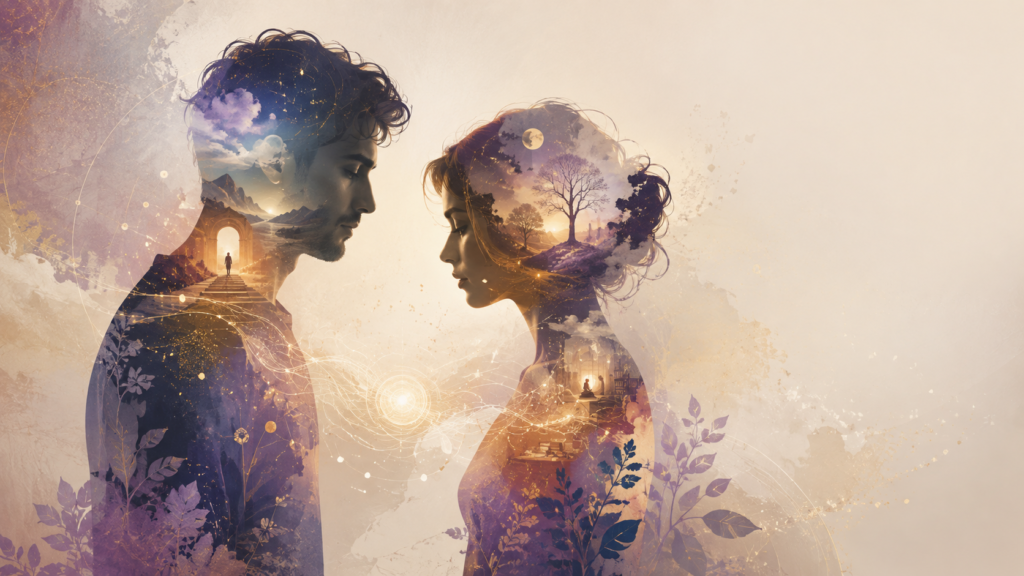
Every human being is a compendium of experiences and exposures. No one is simply male or female, boy or girl. To describe someone merely as a boy, for instance, is often to attach certain expectations to him—to assume that particular realities should naturally emerge through such a person. Yet the truth is far more complex. Every individual is a convergence of experiences drawn from many dimensions of life, each one shaping how that person encounters and expresses the realities of being human.
To be spirit, soul, and body means that every human being is both the sum and the product of spiritual, social, emotional, mental, psychological, and physiological experiences and exposures. When you speak to a man, therefore, you are not merely speaking to a male body; you are engaging a network of experiences gathered within a masculine construct. When you speak to a woman, you are engaging an entire world of exposures, memories, interpretations, desires, and formations concentrated within a feminine construct.
This helps us appreciate why no two people are truly the same, nor could they ever be, unless subjected to some robot-like process of conditioning that gave everyone precisely the same information, experiences, relationships, environments, and opportunities. But life does not work that way. The beauty of human existence lies partly in the almost limitless range of realities to which we can gain access simply by engaging with other people. Relationships, conversations, and meaningful interactions become portals of exploration into worlds we could never experience entirely by ourselves.
The absurdity is that we rarely take full advantage of this privilege. We become so fixated on our differences that we fail to realise that those differences are part of the beauty of human life on earth. Another person does not merely represent something different from you; they carry access to a world you have never lived in.
This understanding should also give us greater wisdom, compassion, and perspective in dealing with people. No matter how similar two individuals may appear, they are two worlds standing beside each other, each existing within the framework of a different whole. Their histories are different. Their memories are different. Their interpretations are different. The meaning they attach to the same event may therefore be completely different.
Consequently, when curating experiences for others, we must recognise that not everyone will encounter them in the same way. What may be exhilarating to one person could be a traumatic trigger for another. What feels harmless to one may awaken painful memories in another. What one person interprets as affection, another may experience as intrusion. This does not necessarily make one person better, wiser, or stronger than the other. It simply reveals the extraordinary difference between the worlds two people can inhabit while standing in exactly the same physical space.
Therefore, when meeting people or attempting to build meaningful relationships, it is important to hold this truth firmly in mind: the person before you is not merely a pretty lady or a handsome gentleman. You are encountering a world of intentionally and unintentionally curated exposures, patterns, experiences, beliefs, wounds, desires, memories, and character.
What we eventually call character is often the accumulated formation of years of exposure, knowledge, experience, interpretation, choices, habits, and desires. So when you seek to make another person part of your own human experience, you must be willing to discover the world within them. This requires intentionally unpeeling the layers of their formation through observation, thoughtful questioning, unbiased interpretation, attentive listening, and creating room for honest expression. Without such investigation, it becomes difficult to know whether two worlds can truly converge, whether they will constantly collide, or whether they will simply bounce off each other without ever achieving meaningful union.
This becomes even more important for those pursuing marriage.
Marriage is not merely the coming together of two bodies. Ideally, it is the fusion of two individually whole persons into one covenantal unit. Yet such a union must take into account that these two people are repositories of separate realities. Each carries a world that existed long before the relationship began.
Each person brings a history of spiritual experiences that has shaped their perception of God, faith, worship, conviction, and spiritual life. Each brings emotional exposures that have influenced how they give and receive love, process disappointment, interpret silence, respond to conflict, and experience intimacy. Each brings mental formations—ideas, assumptions, philosophies, expectations, and ways of interpreting reality. Each brings physical experiences, family patterns, cultural conditioning, financial philosophies, relational memories, ambitions, fears, wounds, and desires.
If these two worlds are to become one, therefore, what is being joined is far more profound than two bodies.
It is two minds, two intellects, two mentalities, two emotional constructs, two histories, two spiritual voyages, two wills, two consciences, two sets of expectations, and two worlds of experience attempting to become one life.
That is why genuine relationship demands more than attraction. It demands discovery. And genuine marital preparation requires more than asking, “Do I love this person?” It must also ask: “What world am I joining myself to—and can our two worlds, under God, be formed into one?”